Tuesday, March 4, 2014


Native Plant Myth 2 Native Plants are Not as Tough as Exotic Plants
Few issues in the gardening world generate as much heat as the debate about native plants. As a result, native plants have developed their own dogma. It’s that dogma that I want to set straight. So I’m here to bust some of the top myths about native plants. Let the smackdown continue:
Myth 2: Native plants are not as tough as exotic plants.
This is one I hear all the time among landscape architects. “This site is too brutal for natives,” a colleague said recently. He was referring to an urban parking lot that would not be irrigated. Implicit in the assumption is the belief that natives are somehow weaker and more delicate than exotics plants.
 |
| Wild some natives like trillium may not be tough enough for urban areas, others are. |
It’s easy to understand where this mythology comes from. A forest of mostly native species gets razed for an office park. The client expresses a desire to use mostly natives on the new site, perhaps as a way to mitigate the fact that an energy-sucking office park just ate a forest. But the conditions have changed now. The precious native ephemerals such as tiarellas, trilliums, and geraniums that thrived under the cool woodland canopy will no longer survive on the edge of a sunny parking lot, especially once the maintenance crew salts it in winter. So the designer reverts to a “tried and true” palette of juniper, berberis, and euonymous to green the parking islands.
This line of thinking is not limited to designers. Senior research scientist of the Arnold Arboretum, Peter Del Tredici wrote, “My advice is simple: don’t limit your planting designs to a palette of native species that might once have grown on the site. Imposing such a limitation on diversity not only reduces the aesthetic possibilities for the landscape, but also its overall adaptability.”
The assumption made in both cases is that the only native plants appropriate for the site are those that used to be there hundreds of years ago. If you leave anywhere east of the Mississippi, that probably means some kind of woodland. Of course, many of these plants would be poorly suited to harsh urbanized conditions. But what about native plants adapted to harsh conditions?
I remember hiking through some of Georgia’s granite rock outcrops and marveling at the ability of native plants to live in utterly desolate conditions. Beautiful patterns of mosses, grasses, and cedars grew in the slimmest pockets of anaerobic soil. These plants withstood blazing heat, drought, periodic inundations, and infertile soil, and deep frosts— conditions remarkably similar to urban environments. And it’s not just granite outcrops. All over the country, native plants thrive in horrifically inhospitable environments. When we limit our understanding of native plants to a few precious woodland floor plants, we lose sight of their potential in human disturbed landscapes.
 |
| Native vegetation on harsh urban-like conditions of granite outcrops in Heggies Rock in Georgia. Painting by Philip Juras. |
I remember hiking through some of Georgia’s granite rock outcrops and marveling at the ability of native plants to live in utterly desolate conditions. Beautiful patterns of mosses, grasses, and cedars grew in the slimmest pockets of anaerobic soil. These plants withstood blazing heat, drought, periodic inundations, and infertile soil, and deep frosts— conditions remarkably similar to urban environments. And it’s not just granite outcrops. All over the country, native plants thrive in horrifically inhospitable environments. When we limit our understanding of native plants to a few precious woodland floor plants, we lose sight of their potential in human disturbed landscapes.
This summer I interviewed Mark Simmons, a research ecologist with the Lady Bird Johnson Wildflower Center. Mark and his colleagues have done a slate of new research that challenges the assumption that native plants are somehow weaker than exotics. Simmons has a revolutionary vision of what urban spaces can be: a place where native plants and ecosystems provide ecological services for humans such as stormwater management, pollution filtration, and habitat creation. “Native plants, as we’re finding, are a hugely untapped resource,” says Simmons.
This vision is backed with cutting-edge research. In 2008 Simmons completed a study that compared the performance of different types of green roofs. Simmons compared 24 different experimental rooftops. The study showed that green roofs with native plants outperformed green roofs with mostly sedums. The native plants captured stormwater and cooled the surfaces better than exotic sedums.
A second study compared the performance of exotic versus native turfgrasses. Early research demonstrates that the lawns composed of a mix of native grasses outperformed the non-native lawn. The native lawn better conserves water, resists disease, and handles foot traffic than the non-native lawn. In addition, the native lawns were indistinguishable in appearance from the non-native lawn.
Simmons’ research shatters stereotypes of natives as weak, underperforming plants. For example, the Texas Department of Transportation was initially hesitant to substitute native grass seeding for the more tried and true exotic Bermuda grass. Simmons tested a way to artificially increase the density of native wildflowers. Not only did the native grasses and wildflowers grow better, but they also reduced populations of the invasive bastard cabbage which grew alongside the Bermuda grass.
 |
| Test plots of native turfgrass outperform exotic species. |
Simmons’ research shatters stereotypes of natives as weak, underperforming plants. For example, the Texas Department of Transportation was initially hesitant to substitute native grass seeding for the more tried and true exotic Bermuda grass. Simmons tested a way to artificially increase the density of native wildflowers. Not only did the native grasses and wildflowers grow better, but they also reduced populations of the invasive bastard cabbage which grew alongside the Bermuda grass.
Simmons is optimisitc about future applicaitons of native ecosystems in urban environments: "Native ecosystems have the potential to improve almost any urban environmental problem."
Port Marine Bristol
Back in the mists of time, when I was just an assistant CAD bitch at Derek Lovejoy Partnership, I can vaguely recall working up proposals for Port Marine, near Bristol. At the time it was quite a big deal - a major new housing project built on a former industrial site, that was going to be a big step up in quality from anything else done by a major housebuilder. Poundbury was very much the role model for the scheme, so we were given lots of scope for nice paving, planting and trees, whilst the architects got a big budget for porticos, quoins and neo-classical garage doors.
Thus it was with some interest that I recently went back to visit the site. Sadly, I couldn’t specifically remember ‘my bits’, but I did have a general sense of déjà vu as I looked around. It’s all a bit of a pastiche, but quite a pleasant one and somewhat unsurprisingly it’s on the Prince’s Trust list of developments that Prince Charles likes.

As you can probably see, there’s a bit of a nautical theme to the area. If the buildings were people, they’d probably be wearing a blue and white stripey top, deck shoes and possibly a neck scarf or captains hat. Quite nicely done though.

Not a great photo this, but it does show one of the green ‘squares’ which are a bit of a feature of the development.

I think in principle, these areas work well. Where they are let down is by the maintenance, particularly in the soft and planted bits, which are looking tired and unkempt. Lot’s of Marshall’s Saxon paving and Conservation kerbs!

You could make the same observation again; while the overall design is interesting, the poor state of the grass detracts from the areas appearance.

Some of the more modern town houses in the scheme.

…and it all goes a bit Poundbury!

A bit of a theme developing here; nice quality housing, rather unkempt road frontage.

I know it’s a bit twee, but I still think this is a reasonably interesting streetscene (bar the big blocky extra floor emerging from the pitched roof on the right hand side). Pastel coloured building renders all look a bit ’west coast of Ireland’ to me.

The offending, big blue block! Front gardens work well in my opinion.

I actually rather like this mini square. It’s a nice scale for the houses around it and the flowering cherries give it a different feel from the surroundings.

Another of the development’s ‘squares’. Quite a nice one actually – I’ve a feeling I designed it!

Port Marines answer to Bath’s ‘Royal Crescent’ – a curve of buildings overlooking the central greenspace. More multi-coloured render.

The central greenspace. Looking generally underwhelming and uncared for. The grotty looking, blocks of concrete were once part of the old harbour in place of more conventional park benches. Nice idea, but all looks a bit random now.

Not really looking any better from this angle. I’m not quite sure what you’re meant to do in this space?!?

The centrepiece of the park, is this Gormley-esque sculpture. In spite of my myself, I actually quite like it. I’m told it was inspired by the five radio towers which used to be a feature of the area. This was the brochure image of the development, and seemed to be widely used as an example of public art.

From the front...

Finally, I thought I’d drop in this image of the big sculpture’s mini me, which is just round the corner. It’s obviously by the same artist, and hopefully gives you a little better idea of the construction. Not sure I like it really. I think that somewhere there must be some Government guidance on public art, which states that a certain percentage MUST be made of corten steel.
I think the overall result is generally pretty pleasant, if not entirely to my taste. Unfortunately the big let down is the maintenance of the public realm and greenspaces. You can’t blame the developer for this, as it is almost certainly down to the local authority that adopted it (and no doubt charged some fat commuted sums for doing so). Interestingly, we showed a client around here as an example for the redevelopment of Llanwern steelworks, and it convinced them to look at a community interest company (CIC) rather than LA adoption. See story here.
Thus it was with some interest that I recently went back to visit the site. Sadly, I couldn’t specifically remember ‘my bits’, but I did have a general sense of déjà vu as I looked around. It’s all a bit of a pastiche, but quite a pleasant one and somewhat unsurprisingly it’s on the Prince’s Trust list of developments that Prince Charles likes.
As you can probably see, there’s a bit of a nautical theme to the area. If the buildings were people, they’d probably be wearing a blue and white stripey top, deck shoes and possibly a neck scarf or captains hat. Quite nicely done though.
Not a great photo this, but it does show one of the green ‘squares’ which are a bit of a feature of the development.
I think in principle, these areas work well. Where they are let down is by the maintenance, particularly in the soft and planted bits, which are looking tired and unkempt. Lot’s of Marshall’s Saxon paving and Conservation kerbs!
You could make the same observation again; while the overall design is interesting, the poor state of the grass detracts from the areas appearance.
Some of the more modern town houses in the scheme.
…and it all goes a bit Poundbury!
A bit of a theme developing here; nice quality housing, rather unkempt road frontage.
I know it’s a bit twee, but I still think this is a reasonably interesting streetscene (bar the big blocky extra floor emerging from the pitched roof on the right hand side). Pastel coloured building renders all look a bit ’west coast of Ireland’ to me.
The offending, big blue block! Front gardens work well in my opinion.
I actually rather like this mini square. It’s a nice scale for the houses around it and the flowering cherries give it a different feel from the surroundings.
Another of the development’s ‘squares’. Quite a nice one actually – I’ve a feeling I designed it!
Port Marines answer to Bath’s ‘Royal Crescent’ – a curve of buildings overlooking the central greenspace. More multi-coloured render.
The central greenspace. Looking generally underwhelming and uncared for. The grotty looking, blocks of concrete were once part of the old harbour in place of more conventional park benches. Nice idea, but all looks a bit random now.
Not really looking any better from this angle. I’m not quite sure what you’re meant to do in this space?!?
The centrepiece of the park, is this Gormley-esque sculpture. In spite of my myself, I actually quite like it. I’m told it was inspired by the five radio towers which used to be a feature of the area. This was the brochure image of the development, and seemed to be widely used as an example of public art.
From the front...
Finally, I thought I’d drop in this image of the big sculpture’s mini me, which is just round the corner. It’s obviously by the same artist, and hopefully gives you a little better idea of the construction. Not sure I like it really. I think that somewhere there must be some Government guidance on public art, which states that a certain percentage MUST be made of corten steel.
I think the overall result is generally pretty pleasant, if not entirely to my taste. Unfortunately the big let down is the maintenance of the public realm and greenspaces. You can’t blame the developer for this, as it is almost certainly down to the local authority that adopted it (and no doubt charged some fat commuted sums for doing so). Interestingly, we showed a client around here as an example for the redevelopment of Llanwern steelworks, and it convinced them to look at a community interest company (CIC) rather than LA adoption. See story here.
Timelessness

It has made me think about why we write articles, share blogs and even create beautiful gardens. It seems to me that people who see beauty acutely tend to see and feel pain sharply too. By seeking the beautiful and sharing it we share some of the comfort and joy which we find there. By surrounding ourselves with lovely living things it makes the harder facts of life easier to bear, it puts small disappointments in context and allows us time to reflect on the larger picture. By giving a little happiness we are happier ourselves.
Much as we try to create beauty and harmony though all gardeners know that they cannot control all things. I take a little comfort from that too, allowing my usual trail of unfinished projects and general chaos to gently remind me that perfection is unattainable.
No photo of my own garden could do such an inspiring person justice, so in memory of Elspeths timeless qualities here are two images of a landscape which remind me that they are made by another hand.

Monday, March 3, 2014
Red Valerian
Centranthus ruber
Also called Jupiters Beard. A bushy, woody-based perennial, reaching a maximum size of 6.6 x 4 ( rarely over 3 x 2.5 ) feet, that is native to Europe and western Asia.
It can be invasive on some sites.
The fleshy leaves, up to 6 ( averaging 3.2 ) inches in length, are fleshy and green.
The red or deep pink flowers, up to 0.8 inches across, are borne on showy large, rounded inflorescences, up to 4 inches across, from late spring through summer.
They attract butterflies.
Hardy zones 3 to 9 in full sun to partial shade on just about any well drained soil It is very easy to grow. Drought tolerant as well as tolerant of extreme heat up to 116 F in full sun as well as highly alkaline soil. Rabbit but not deer resistant.
Cut to ground during late August. Propagation is from seed or division though the roots may be tough to cut apart.
Albus
Same except with the flowers being pure white.
Coccineus
Also called Atrococcineus. Same except with the flowers being deep red.
Read More..
Also called Jupiters Beard. A bushy, woody-based perennial, reaching a maximum size of 6.6 x 4 ( rarely over 3 x 2.5 ) feet, that is native to Europe and western Asia.
It can be invasive on some sites.
The fleshy leaves, up to 6 ( averaging 3.2 ) inches in length, are fleshy and green.
The red or deep pink flowers, up to 0.8 inches across, are borne on showy large, rounded inflorescences, up to 4 inches across, from late spring through summer.
They attract butterflies.
Hardy zones 3 to 9 in full sun to partial shade on just about any well drained soil It is very easy to grow. Drought tolerant as well as tolerant of extreme heat up to 116 F in full sun as well as highly alkaline soil. Rabbit but not deer resistant.
Cut to ground during late August. Propagation is from seed or division though the roots may be tough to cut apart.
Albus
Same except with the flowers being pure white.
Coccineus
Also called Atrococcineus. Same except with the flowers being deep red.
Mulch Addiction
The United States of Mulch. Why do we use too much mulch? What is the alternative?

One of the idiosyncrasies of the built American landscape is our fascination with mulch. It’s in our yards and gardens; it is in the parking lots of our fast food chains and grocery stores; and it is in our airports and along our highways. We spread it everywhere. We spread it thickly.
Our use of mulch is so ubiquitous and so frequent, it is easy to forget how unusual this habit is. Traveling through Europe or Asia, however, the contrast is clear. In most other countries, it is the plants themselves that occupy the most space; here, however, mulch is often even more visually dominant than the plants themselves. I remember a friend from Europe asking me once, “Why are Americans so proud of their mulch?” At the time, it had not really occurred to me that we use mulch more than other parts of the world, but slowly I too began to see that he was right. What is curious to me is that our mulch addiction is not limited to socioeconomic class or status. The liberal use of mulch is as prevalent on wealthy estates as it is on strip malls and tract housing. And it has little to do with training. Thick blankets of mulch are specified by landscape architects as often as maintenance crews.
Where do we get this peculiar habit? Perhaps part of the issue is that mulch is abundant and cheap. We’ve always had lots of trees. Mulch is a byproduct of the large timber industry, making it relatively affordable. Perhaps our use of mulch is a result of the fact that our landscapes regenerate so quickly. A recent blog by Noel Kingsbury remarked on how quickly the American woodland regenerates compared to English forests. It’s true: if you leave a piece of cleared land alone almost anywhere east of the Mississippi River, it will likely revert to an invasive-choked woodland within a decade. Below our lawns and suburbs, there is a feral landscape just waiting for its chance. Perhaps we mulch (and mow) to keep the beast at bay.
 |
| The beast beneath: left alone for even a few years, wild vegetation eventually takes over. Do we mulch to keep this at bay? |
Maybe the better question to ask is not why we mulch, but what is the alternative? A few weekends ago I went camping with some friends in the Shenandoah National Park. We camped at a relatively high elevation. I pondered the wild plant communities that were obviously thriving in a relatively harsh environment. Shallow and infertile soils, high winds, and harsh exposures--conditions similar to most urban environments--typified the ridgeline, yet despite this, the ground was almost entirely covered with plants. A rich carpet of ferns, sedges, and forbs covered even the slightest depressions
Nature abhors bare soil. With the exceptions of deserts or other extreme climates, bare soil is almost always a temporary condition in the wild. What is it about the structure and composition of wild plant communities that creates this rich ground-covering layer? What can we learn from native plant communities that can improve the way we design our plantings--strategies to make our landscapes both more beautiful and more enduring?
 |
| Green mulch. Nature abhors bare soil and fills it will a rich layer of different ground-holding plants |
I am happy to say that I am working on a book to answer exactly those questions. I am collaborating with Claudia West, a brilliant landscape architect and plants-woman who works for North Creek Nurseries. The book is focused on native planting design, paying particular attention to how understanding the layers and dynamics of plant communities in the wild can improve our designed plantings. The book will be published by Timber Press. More on Claudia and the book later.
The alternative to mulch is what Claudia calls “green mulch,” that is, plants themselves. A lot more plants. In a recent discussion with Claudia, she pointed out that our habit of continually adding mulch year after year artificially keeps our plantings in a perpetual establishment phase. Vertically layering our plantings with different kinds of forbs, graminoids, ferns, and woody species to form a dense carpet can indeed create plantings that need little or no mulch.
This process of vertically layering requires a lot of plants. Woody shrubs must be under-planted with herbaceous species. Tall grasses may need to be under-planted with lower sedges. Perennial borders will require multiple layers of ground-holding plants to support taller accent species. The goal of this kind of layering is not just to reduce our use of mulch, but also to create more stable, enduring, and even more beautiful plantings.
 |
| Verbena bonariensis and Phlomis tuberosa. Two self-seeding plants in my garden that I hope to encourage |
This past year, I stopped mulching my perennial border. It was a fascinating experiment. Instead of mulch, I gently worked a bit of compost in the spring with a fork--being careful not to cover the ground, but instead get the compost into the soil. In most places, I found that the plants I had were dense enough already to choke out any weeds. In a few places, weeds appeared under taller, upright perennials. Those areas highlighted for me a missing “layer” of plants that I will add next spring. The other more surprising benefit was how much self-seeding happened as a result of not mulching. The appearance of these self-seeders added a much needed spontaneous element to the border, threading it together more fully than what I could have done on my own. This look of spontaneity and naturalness is incredibly hard to create. Next year, I’m hoping self-seeders play an even larger role in the garden.
I look forward to developing these ideas more fully and sharing our research along the way. Stay tuned . . .
Perennial Sunflowers
Helianthus - Perennial Sunflowers
Mostly hardy zones 6 to 10 in sun to partial shade. The flowers on many attract butterflies and hummingbirds. Most love hot summers and are very easy to grow.
All Sunflowers prefer fertile, preferrably alkaline, moist soil and respond very well with vigor to frequent fertilizer application preferrably organic. They are easily grown from seed. Perennial species can be divided during autumn or early spring.
While everyone knows the Annual Sunflower, famous for its giant flowers and edible seeds, comparatively few are familiar with its often spectacular perennial relatives.
Indeed the Annual Sunflower ( Helianthus annuus ) is often planted as an agricultural crop often over very large acreage in eastern Europe, Russia and central North America.
Sunflower seeds are highly nutritious. They contain close to 40% fat ( much of it essential fatty acids ), as well as 20% carbs and protein. Sunflower seed also contains Vitamin A, many Bs, Vinamin E, many minerals and even Vitamin D which rarely occurs in plants and is often deficient in people living in climates with sparse sunshine. Sunflower oil can be used as both a skin lotion and massage oil. A single acre of Annual Sunflower can produce up to 100 gallons of Sunflower Oil.
Many birds also find Sunflowers to be very nutritious and Sunflower seed is often sold in large bags for birdfood. The Seeds of all other Helianthus can be used in the same way however the seeds of many other Helianthus are too small to be used commercially.
Perennial Sunflowers can be cut back during early summer for shorter later flowering plants. They are often cut back hard after flowering though sometimes left along until early winter since birds enjoy the seeds.
Propagation is from seed or division every 3 years during autumn or spring.
* photo of unknown internet source


Helianthus angustifolius ( Narrow-leaved Sunflower )
Also called Swamp Sunflower. A rapid spreading, clump-forming, very large perennial reaching up to 10 x 10 feet that is native from Iowa to Pennsylvania to Long Island; south to Texas to Florida. It is found in pinelands and bogs in the wild, they look great with Switch Grass in the natural landscape.
The bristly stems bear alternately arranged, sessile, narrow lance shape foliage up to 12 inches in length with rolled down edges.
The golden-yellow flowers, up to 3 inches across, are borne late summer into early autumn. The seed heads that follow are loved by birds.
Hardy zones 6 to 9 in full sun on well drained soil. Drought / clay tolerant, salt & deer resistant. Cut back hard during mid-summer for denser habit.
* photos taken on October 17 2010 @ U.S. National Arboretum, D.C.


Gold Lace
Reaches up to 6 x 5 feet with finely textured deep green foliage and profuse golden-yellow flowers borne during early autumn, earlier than the species.
Low Down
A miniature form, reaching a maximum size of only 20 inches x 3 feet.
* photos taken on Oct 6 2012 in Howard Co., MD

* photo taken on Sep 23 2013 in Burtonsville, MD

Matanzas Creek
Reaches up to 8 x 6 feet in 5 years, eventually broader, with strong sturdy stems bearing very large spikes of very abundant, showy light yellow flowers. The flowers are borne over a long season during mid to late autumn and it may not be suitable where early fall frost may cut the bloom season short.
Mellow Yellow
Reaches up to 10 feet with abundant pastel-yellow flowers; otherwise identical.
Helianthus atrorubens ( Dark Eyed Sunflower )
A perennial, reaching up to 8 x 6 ( rarely over 6 ) feet, that is native to open woodlands in the southeastern U.S. ( Louisiana to Virginia; south to Florida )
The toothed, oval leaves are up to 12 inches in length, The foliage is mid-green.
The deep golden orange-yellow ( with purplish-red center ) flowers, up to 4 ( rarely over 2 ) inches across, are borne during late summer into early autumn.
Hardy zones 7 to 9 in full sun to partial shade.
Helianthus debilis ( Beach Sunflower )
A trailing to semi-upright perennial, reaching a maximum size of 7 x 6 feet, that is native to sandy coastal plains in eastern North America ( from Texas to Florida and north to Maine ).
The either toothed or non-toothed leaves, up to 4 inches in length, are alternately-arranged and borne on long stalks.
The bright yellow flowers, up to 5 inches across, are borne early summer to mid-autumn.
Hardy zones 6 to 9 in full sun on sandy, well drained soil. It is extremely salt tolerant and makes an excellent groundcover in coastal areas.
Helianthus decapetalus ( Thinleaf Sunflowers )
A vigorously spreading, large perennial reaching up to 6.5 x 6.5 feet, that is native to the central and eastern U.S.
The rough, cordate, green leaves are up to 8 inches in length.
The pale yellow ( with deeper yellow center ) flowers, up to 6 inches across, are borne during mid-summer into early autumn.
Hardy north to zone 3, in full sun. Powdery mildew may become a problem on plants under drought stress.
Capenoch Star
Full upright plant reaching up to 6 x 6.5 feet with creeping rhizomes that form a large patch.
The leaves, up to 8 inches in length, are deep green.
The large, single, light yellow flowers, up to 8 inches across, are borne mid summer into autumn.
Hardy north to zone 4
Plenus
Reaches up to 5 feet in height with large, bright yellow, double flowers from mid summer to early autumn.
Helianthus divaricatus ( Woodland Sunflower )
A perennial, reaching up to 7 x 4 feet, that is native to dry woodlands in eastern North America ( from Saskatchewan to Maine; south to Arkansas to Florida ).
The stemless, oppositely-arranged, lance-shaped leaves, up to 8 x 3 inches, are bright green.
The bright yellow flowers, up to 2 inches across, are borne mid-summer to mid autumn.
Hardy zones 3 to 8 in partial shade on well drained soil.
* photos taken on Aug 4 2013 in Bayfield, Ontario


Chartreuse Butterflies
* see external link
http://www.chicagolandgrows.org/perennials/butterflies.php
Helianthus giganteus ( Tall Sunflower )
A very large perennial reaching up to 15 x 6 feet that is native to swamps and wet meadows from Minnesota to Ontario & Nova Scotia; south to Mississippi to Georgia.
The lance shaped leaves are slender and up to 8 inches in length.
The branched flower stems bear golden-yellow flowers, up to 3 inches across, during early autumn.
The seeds are useful in the same way as Annual Sunflower.
The roots are also edible.
Hardy zones 4 to 9 in full sun.
* photo of unknown internet source

Sheilas Sunshine
Reaches up to 10 x 6 feet, with pale yellow flowers during early autumn.
Hardy zones 5 to 9.
Helianthus hirsutus ( Hairy Sunflower )
A dense colony-forming perennial, up to 6 x 3 feet with 3 inch light-yellow flowers borne late summer to mid autumn. The lance-shaped leaves are rough and mid-green. Hardy zones 3 to 8 in full sun to partial shade.
* photos taken on June 30 2013 @ Grand Bend, Ontario


Helianthus laetiflorus var rigidus ( Showy Sunflower )
A rapid rhizomatous spreader reaching up to 8 feet with upright stems. It is native to open woodlands from Saskatchewan to Quebec; south to New Mexico to Georgia.
The rough, shiny green narrow ovate leaves are up to 11 inches in length. The profuse flowers, up to 4 inches across, are dark centered, single, bright yellow daisies borne mid July to late September.
Hardy zones 3 to 9 preferring moist soil but is very drought / clay tolerant. Over fertilizing may encourage top heavy plants that flop over.
Lemon Queen
A fast growing to invasive, sturdy, upright perennial to 8 x 6 feet with light yellow single flowers up to 3 inches across borne mid-summer well into autumn. A 1 gallon size plant may clump out to 4 feet in just one season.
The foliage is luxuriant deep green.
Hardy zones 3 to 9
* photos taken on Aug 20 2011 @ Brookside Gardens, Wheaton, MD

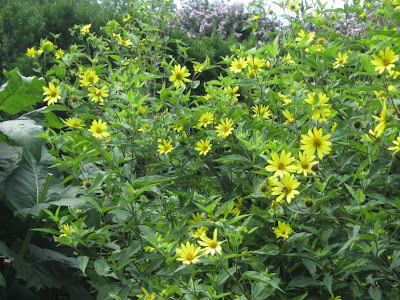


* photos taken on Sep 15 2013 in Howard Co., MD


* photos taken on Sep 26 2013 in Baltimore Co., MD


Helianthus maximilianii ( Maximilians Sunflower )
A very aggressive growing large perennial reaching up to 12 x 6 feet. It is native from British Columbia to Maine; south into the U.S found anywhere from prairies to swamps. It grows from a thick edible rhizome. Great for use against a fence and even as a perennial hedge, it is among the most spectacular of all fall blooming perennials.
The thick, smooth-edged or shallow-toothed, lance-shaped leaves are up to 12 inches in length, are blue-green. The foliage is rough textured.
The flowers, up to 6 inches in width, are bright golden-yellow, single daisies born September into November. The flowers attract butterflies. Taller later blooming seed source may not have time to bloom in the north before autumn frosts arrive.
The seeds are useful in the same way as Annual Sunflower, they are often left on the plants to attract birds. It has potential as a perennial seed crop.
The roots are also edible in the same way as Helianthus tuberosus and the natives used it as a food source who roasted and boiled it.
Hardy zones 3 to 8 ( use shorter northern seed source for northern regions ) in full sun on well drained soil. Very heat, drought and clay tolerant. Deer and rabbit resistant.
Propagation is easy from seed and self sowing often occurs. Division is also easily done during autumn immediately after cutting back after the stalks die back. The stalks are cut back to the ground during the winter to make room for new growth in the spring.
* photo of unknown internet source

Dakota Sunshine
Similar but exceptionally cold hardy, still north to zone 3 but thriving even where the growing seasons are very short such as in the high plains.
It reaches up to 6 x 5 feet, and has the typical attractive luxuriant green foliage and showy golden-yellow daisies.
Lemon Yellow
Similar but reaches up to 6 x 3 feet, bearing lemon-yellow flowers rather than the typical deeper golden-yellow.
Santa Fe
A clone, reaching up to 8 x 4 feet, that is offered by High Country Gardens.
The attractive foliage is deep green and the stunning, large, golden-yellow flowers are borne during mid autumn.
Helianthus microcephalus
A perennial, reaching up to 13 ( rarely over 6 ) x 4 feet, that is native to the central U.S.
The bright yellow flowers, up to 3 inches across, are borne over a long season during late summer into early autumn.
Hardy zones 4 to 8 in full sun on moist soil. Clay tolerant.
Helianthus mollis ( Downy Sunflower )
A long-lived perennial, reaching a maximum size of 5.8 x 7.2 ( rarely over 4.5 ) feet, that is native to eastern North America ( Wisconsin to Massachusetts; south to Oklahoma to Texas to northern Georgia ).
The foliage appears gray-green as it is covered in downy white hairs.
The abundant, large, deep yellow flowers, up to 3 inches across, are borne during late summer into autumn.
Hardy zones 4 to 8 in full sun. Tolerant of poor soils and severe drought.
Easy to grow.
Helianthus x multiflorus
Perennials, reaching a maximum size of 7 x 3 feet. They are hybrids between the annual sunflower Helianthus annuus and the perennial Helianthus decapetalus.
The lance-shaped leaves are up to 8 inches in length. The foliage is coarsely hairy.
The flowers, up to 5 inches across, are borne late summer until autumn frosts.
Hardy zones 4 to 8 in full sun on consistently moist, well drained soil.
Propagation is from vegetative stem cuttings with intermittent mist and bottom heat.
Sunshine Daydream
Originated as a branch sport of Capenoch Star, reaching up to 6 x 4 feet, with very dense foliage that is lush even in extreme summer heat.
The very profuse, fully double, golden-yellow, Dahlia-like blooms are borne continuously from early to late summer.
Hardy zones 4 to 8. The foliage is mildew resistant.
Heliantus nuttallii ( Nuttalls Sunflower )
Similar to Helianthus tuberosus but much smaller ( up to 7 feet, very rarely as much as 13 feet ) and less vigorous. It is native to moist meadows in the Rocky Mountains ( southeast British Columbia to Saskatchewan; south to Oregon to Nevado to New Mexico )
The narrow leaves are mid-green.
The deep yellow flowers, up to 4 inches across, have an orange ring around the center which is also deep yellow. They are borne during early fall.
Hardy zones 5+ in full sun.
Helianthus occidentalis
A perennial, reaching up to 6.5 x 2.5 feet, that is native to the central U.S.
The abundant, deep yellow flowers, up to 2.5 inches across, are borne late summer into early autumn.
Hardy zones 4 to 8 in full sun.
Helianthus petiolaris ( Prairie Sunflower )
Helianthus salicifolius ( Willow-leafed Sunflower )
A large, upright, perennial reaching up to 10 x 7 feet that is native from Colorado to Nebraska and western Missouri; south to northern Texas & Oklahoma. It can be invasive as the long rhizomes form large clumps. This plant is an excellent companion plant for larger Asters and Echinacea.
The tropical looking drooping foliage, up to 12 inches in length, is willow-like and deep green turning bright yellow late in autumn. Masses of 3 inch, bright yellow daisies with dark centers are borne late summer to mid autumn.
Hardy zones 3 to 9, prefers moist fertile soil but is tolerant of dry soil and likes lime. Cutting plants back in mid June will make them shorter but more strong and compact.
* photos taken on Sep 24 2013 in Howard Co., MD


Bitter Chocolate
Shorter, rarely exceeding 6 feet in height, bearing large flowers, up to 3 inches across, earlier in the season.
First Light
A dwarf form only reaching up to 4 x 4 feet with very abundant, golden-yellow flowers with brown eyes borne in mid autumn. Very sturdy in habit, it does not need staking.
Hardy zones 5 to 9
* photo taken on October 14 2010 in Crownsville, MD

* photo taken on Sep 26 2013 in Baltimore Co., MD

Helianthus simulans ( Muck Sunflower )
A perennial, reaching a maximum size of 12 x 10 ( rarely over 10 ) feet, that is native to wet sites in the southeastern U.S. ( Arkansas to Tennessee; south to Louisiana to Florida ).
Very attractive even when not in bloom, the plants resemble some species of Bamboo in appearance.
The narrow, lance-shaped leaves, up to 9 x 1.3 inches, are luxuriant mid-green.
The foliage is similar to that of H. angustifolia.
The abundant, golden-yellow ( with purple-red center ) flowers, up to 3 inches across, are borne mid autumn until the first hard freeze, even it that is in late November.
Hardy zones 6 to 9 in full sun on moist to wet soil. Cut back by 1/3 during June to encourage bushiness.
* photos taken on Aug 20 2011 @ Brookside Gardens, Wheaton, MD


Helianthus strumosus ( Paleleaf Woodland Sunflower )
A fast spreading ( sometimes invasive ) perennial, reaching a maximum size of 7 x 3 ( rarely over 4 ) feet, that is native to eastern North America ( from Minnesota to Ontario to Maine; south to Texas to Florida ).
The large, yellow flowers, up to 4 inches wide, are borne for up to a month or more during mid summer to early autumn.
Hardy zones 4 to 8 in partial shade. Easy to grow.
Helianthus tuberosus ( Jerusalem Artichoke )
A very fast growing, large perennial, reaching up to 12 x 5 + feet, that is native to the Great Plains of North America ( Montana to Saskatchewan to Ontario; south to Colorado to north-central Texas to Georgia and naturalized further east ). It is usually found on floodplains and open woodlands in the wild.
The toothed, ovate leaves, up to 10 inches across, are mid-green. The leaves are alternately-arranged.
The abundant flowers, up to 4 inches across, are bright yellow and very attractive. They are borne late summer to mid-summer.
Hardy zones 4 to 8 in full sun on fertile, moist soil. The Jerusalem Artichoke prefers climates with cool to cold winters. Heat and drought tolerant, they are not often bothered by insect pests or disease.
These plants rarely produce good seed but are easy to reproduce from tubers or even tuber fragments. You can often find these tubers in produce markets.
Jerusalem Artichoke is harvested during mid to late autumn after the foliage dies down by digging the tubers. Theyre flavor is enhanced after the first few hard frosts. Digging the tubers is rarely harmful to the Jerusalem Artichoke since some always get left behind and grow to form new plants the following spring. In fact ones you plant Jerusalem Artichoke in the garden, it is usually very difficult to get rid of. The tubers contain lots of minerals but only 75 calories per pound.
The tubers can be stored in moist sand but generally dont last long once they are dug. Therefore it is important to only dig what you can use. In fact you can repeatedly dig them all winter long as long as the soil isnt frozen solid.
The tubers contain insulin and taste much better after baking which converts the insulin into sugar, making them sweeter. They can be stir fried and even eaten fresh in salads. The tubers can even be grounded into flour for diet pasta, baking or soup thickening, after they have been dried.
The tubers of the Jerusalem Artichoke can be boiled as well but overcooking will make them mushy.
To prepare the tubers, clean out the crevices but you do not need to peel them. Cutting off and replanting the knobby parts is recommended since you never want a good plant to go to waste.
Up to 20 tons of tubers may be produced per acre and the plant can be used to manufacture fuel alcohol.
The tubers make excellent pig feed, and pigs are the best way to eliminate this plant when the crop is no longer needs.
* photo taken on Aug 4 2012 in Bayfield, Ontario

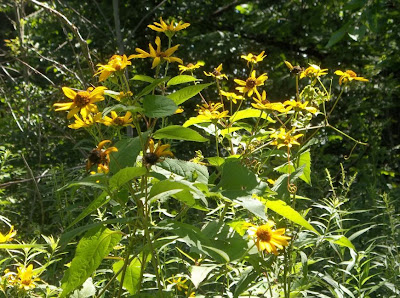


* photos taken on Sep 3 2013 in Ellicott City, MD


* photos taken on Sep 15 2013 in Howard Co., MD


Helianthus verticillatus ( Whorled Sunflower )
A very tall perennial reaching up to 12 feet that is native to Alabama where it is nearly extinct. The flowers are up to 3 inches across.
Hardy north to zone 5
* photo of unknown internet source

Read More..
Mostly hardy zones 6 to 10 in sun to partial shade. The flowers on many attract butterflies and hummingbirds. Most love hot summers and are very easy to grow.
All Sunflowers prefer fertile, preferrably alkaline, moist soil and respond very well with vigor to frequent fertilizer application preferrably organic. They are easily grown from seed. Perennial species can be divided during autumn or early spring.
While everyone knows the Annual Sunflower, famous for its giant flowers and edible seeds, comparatively few are familiar with its often spectacular perennial relatives.
Indeed the Annual Sunflower ( Helianthus annuus ) is often planted as an agricultural crop often over very large acreage in eastern Europe, Russia and central North America.
Sunflower seeds are highly nutritious. They contain close to 40% fat ( much of it essential fatty acids ), as well as 20% carbs and protein. Sunflower seed also contains Vitamin A, many Bs, Vinamin E, many minerals and even Vitamin D which rarely occurs in plants and is often deficient in people living in climates with sparse sunshine. Sunflower oil can be used as both a skin lotion and massage oil. A single acre of Annual Sunflower can produce up to 100 gallons of Sunflower Oil.
Many birds also find Sunflowers to be very nutritious and Sunflower seed is often sold in large bags for birdfood. The Seeds of all other Helianthus can be used in the same way however the seeds of many other Helianthus are too small to be used commercially.
Perennial Sunflowers can be cut back during early summer for shorter later flowering plants. They are often cut back hard after flowering though sometimes left along until early winter since birds enjoy the seeds.
Propagation is from seed or division every 3 years during autumn or spring.
* photo of unknown internet source
Helianthus angustifolius ( Narrow-leaved Sunflower )
Also called Swamp Sunflower. A rapid spreading, clump-forming, very large perennial reaching up to 10 x 10 feet that is native from Iowa to Pennsylvania to Long Island; south to Texas to Florida. It is found in pinelands and bogs in the wild, they look great with Switch Grass in the natural landscape.
The bristly stems bear alternately arranged, sessile, narrow lance shape foliage up to 12 inches in length with rolled down edges.
The golden-yellow flowers, up to 3 inches across, are borne late summer into early autumn. The seed heads that follow are loved by birds.
Hardy zones 6 to 9 in full sun on well drained soil. Drought / clay tolerant, salt & deer resistant. Cut back hard during mid-summer for denser habit.
* photos taken on October 17 2010 @ U.S. National Arboretum, D.C.
Gold Lace
Reaches up to 6 x 5 feet with finely textured deep green foliage and profuse golden-yellow flowers borne during early autumn, earlier than the species.
Low Down
A miniature form, reaching a maximum size of only 20 inches x 3 feet.
* photos taken on Oct 6 2012 in Howard Co., MD
* photo taken on Sep 23 2013 in Burtonsville, MD
Matanzas Creek
Reaches up to 8 x 6 feet in 5 years, eventually broader, with strong sturdy stems bearing very large spikes of very abundant, showy light yellow flowers. The flowers are borne over a long season during mid to late autumn and it may not be suitable where early fall frost may cut the bloom season short.
Mellow Yellow
Reaches up to 10 feet with abundant pastel-yellow flowers; otherwise identical.
Helianthus atrorubens ( Dark Eyed Sunflower )
A perennial, reaching up to 8 x 6 ( rarely over 6 ) feet, that is native to open woodlands in the southeastern U.S. ( Louisiana to Virginia; south to Florida )
The toothed, oval leaves are up to 12 inches in length, The foliage is mid-green.
The deep golden orange-yellow ( with purplish-red center ) flowers, up to 4 ( rarely over 2 ) inches across, are borne during late summer into early autumn.
Hardy zones 7 to 9 in full sun to partial shade.
Helianthus debilis ( Beach Sunflower )
A trailing to semi-upright perennial, reaching a maximum size of 7 x 6 feet, that is native to sandy coastal plains in eastern North America ( from Texas to Florida and north to Maine ).
The either toothed or non-toothed leaves, up to 4 inches in length, are alternately-arranged and borne on long stalks.
The bright yellow flowers, up to 5 inches across, are borne early summer to mid-autumn.
Hardy zones 6 to 9 in full sun on sandy, well drained soil. It is extremely salt tolerant and makes an excellent groundcover in coastal areas.
Helianthus decapetalus ( Thinleaf Sunflowers )
A vigorously spreading, large perennial reaching up to 6.5 x 6.5 feet, that is native to the central and eastern U.S.
The rough, cordate, green leaves are up to 8 inches in length.
The pale yellow ( with deeper yellow center ) flowers, up to 6 inches across, are borne during mid-summer into early autumn.
Hardy north to zone 3, in full sun. Powdery mildew may become a problem on plants under drought stress.
Capenoch Star
Full upright plant reaching up to 6 x 6.5 feet with creeping rhizomes that form a large patch.
The leaves, up to 8 inches in length, are deep green.
The large, single, light yellow flowers, up to 8 inches across, are borne mid summer into autumn.
Hardy north to zone 4
Plenus
Reaches up to 5 feet in height with large, bright yellow, double flowers from mid summer to early autumn.
Helianthus divaricatus ( Woodland Sunflower )
A perennial, reaching up to 7 x 4 feet, that is native to dry woodlands in eastern North America ( from Saskatchewan to Maine; south to Arkansas to Florida ).
The stemless, oppositely-arranged, lance-shaped leaves, up to 8 x 3 inches, are bright green.
The bright yellow flowers, up to 2 inches across, are borne mid-summer to mid autumn.
Hardy zones 3 to 8 in partial shade on well drained soil.
* photos taken on Aug 4 2013 in Bayfield, Ontario
Chartreuse Butterflies
* see external link
http://www.chicagolandgrows.org/perennials/butterflies.php
Helianthus giganteus ( Tall Sunflower )
A very large perennial reaching up to 15 x 6 feet that is native to swamps and wet meadows from Minnesota to Ontario & Nova Scotia; south to Mississippi to Georgia.
The lance shaped leaves are slender and up to 8 inches in length.
The branched flower stems bear golden-yellow flowers, up to 3 inches across, during early autumn.
The seeds are useful in the same way as Annual Sunflower.
The roots are also edible.
Hardy zones 4 to 9 in full sun.
* photo of unknown internet source
Sheilas Sunshine
Reaches up to 10 x 6 feet, with pale yellow flowers during early autumn.
Hardy zones 5 to 9.
Helianthus hirsutus ( Hairy Sunflower )
A dense colony-forming perennial, up to 6 x 3 feet with 3 inch light-yellow flowers borne late summer to mid autumn. The lance-shaped leaves are rough and mid-green. Hardy zones 3 to 8 in full sun to partial shade.
* photos taken on June 30 2013 @ Grand Bend, Ontario
Helianthus laetiflorus var rigidus ( Showy Sunflower )
A rapid rhizomatous spreader reaching up to 8 feet with upright stems. It is native to open woodlands from Saskatchewan to Quebec; south to New Mexico to Georgia.
The rough, shiny green narrow ovate leaves are up to 11 inches in length. The profuse flowers, up to 4 inches across, are dark centered, single, bright yellow daisies borne mid July to late September.
Hardy zones 3 to 9 preferring moist soil but is very drought / clay tolerant. Over fertilizing may encourage top heavy plants that flop over.
Lemon Queen
A fast growing to invasive, sturdy, upright perennial to 8 x 6 feet with light yellow single flowers up to 3 inches across borne mid-summer well into autumn. A 1 gallon size plant may clump out to 4 feet in just one season.
The foliage is luxuriant deep green.
Hardy zones 3 to 9
* photos taken on Aug 20 2011 @ Brookside Gardens, Wheaton, MD
* photos taken on Sep 15 2013 in Howard Co., MD
* photos taken on Sep 26 2013 in Baltimore Co., MD
Helianthus maximilianii ( Maximilians Sunflower )
A very aggressive growing large perennial reaching up to 12 x 6 feet. It is native from British Columbia to Maine; south into the U.S found anywhere from prairies to swamps. It grows from a thick edible rhizome. Great for use against a fence and even as a perennial hedge, it is among the most spectacular of all fall blooming perennials.
The thick, smooth-edged or shallow-toothed, lance-shaped leaves are up to 12 inches in length, are blue-green. The foliage is rough textured.
The flowers, up to 6 inches in width, are bright golden-yellow, single daisies born September into November. The flowers attract butterflies. Taller later blooming seed source may not have time to bloom in the north before autumn frosts arrive.
The seeds are useful in the same way as Annual Sunflower, they are often left on the plants to attract birds. It has potential as a perennial seed crop.
The roots are also edible in the same way as Helianthus tuberosus and the natives used it as a food source who roasted and boiled it.
Hardy zones 3 to 8 ( use shorter northern seed source for northern regions ) in full sun on well drained soil. Very heat, drought and clay tolerant. Deer and rabbit resistant.
Propagation is easy from seed and self sowing often occurs. Division is also easily done during autumn immediately after cutting back after the stalks die back. The stalks are cut back to the ground during the winter to make room for new growth in the spring.
* photo of unknown internet source
Dakota Sunshine
Similar but exceptionally cold hardy, still north to zone 3 but thriving even where the growing seasons are very short such as in the high plains.
It reaches up to 6 x 5 feet, and has the typical attractive luxuriant green foliage and showy golden-yellow daisies.
Lemon Yellow
Similar but reaches up to 6 x 3 feet, bearing lemon-yellow flowers rather than the typical deeper golden-yellow.
Santa Fe
A clone, reaching up to 8 x 4 feet, that is offered by High Country Gardens.
The attractive foliage is deep green and the stunning, large, golden-yellow flowers are borne during mid autumn.
Helianthus microcephalus
A perennial, reaching up to 13 ( rarely over 6 ) x 4 feet, that is native to the central U.S.
The bright yellow flowers, up to 3 inches across, are borne over a long season during late summer into early autumn.
Hardy zones 4 to 8 in full sun on moist soil. Clay tolerant.
Helianthus mollis ( Downy Sunflower )
A long-lived perennial, reaching a maximum size of 5.8 x 7.2 ( rarely over 4.5 ) feet, that is native to eastern North America ( Wisconsin to Massachusetts; south to Oklahoma to Texas to northern Georgia ).
The foliage appears gray-green as it is covered in downy white hairs.
The abundant, large, deep yellow flowers, up to 3 inches across, are borne during late summer into autumn.
Hardy zones 4 to 8 in full sun. Tolerant of poor soils and severe drought.
Easy to grow.
Helianthus x multiflorus
Perennials, reaching a maximum size of 7 x 3 feet. They are hybrids between the annual sunflower Helianthus annuus and the perennial Helianthus decapetalus.
The lance-shaped leaves are up to 8 inches in length. The foliage is coarsely hairy.
The flowers, up to 5 inches across, are borne late summer until autumn frosts.
Hardy zones 4 to 8 in full sun on consistently moist, well drained soil.
Propagation is from vegetative stem cuttings with intermittent mist and bottom heat.
Sunshine Daydream
Originated as a branch sport of Capenoch Star, reaching up to 6 x 4 feet, with very dense foliage that is lush even in extreme summer heat.
The very profuse, fully double, golden-yellow, Dahlia-like blooms are borne continuously from early to late summer.
Hardy zones 4 to 8. The foliage is mildew resistant.
Heliantus nuttallii ( Nuttalls Sunflower )
Similar to Helianthus tuberosus but much smaller ( up to 7 feet, very rarely as much as 13 feet ) and less vigorous. It is native to moist meadows in the Rocky Mountains ( southeast British Columbia to Saskatchewan; south to Oregon to Nevado to New Mexico )
The narrow leaves are mid-green.
The deep yellow flowers, up to 4 inches across, have an orange ring around the center which is also deep yellow. They are borne during early fall.
Hardy zones 5+ in full sun.
Helianthus occidentalis
A perennial, reaching up to 6.5 x 2.5 feet, that is native to the central U.S.
The abundant, deep yellow flowers, up to 2.5 inches across, are borne late summer into early autumn.
Hardy zones 4 to 8 in full sun.
Helianthus petiolaris ( Prairie Sunflower )
Helianthus salicifolius ( Willow-leafed Sunflower )
A large, upright, perennial reaching up to 10 x 7 feet that is native from Colorado to Nebraska and western Missouri; south to northern Texas & Oklahoma. It can be invasive as the long rhizomes form large clumps. This plant is an excellent companion plant for larger Asters and Echinacea.
The tropical looking drooping foliage, up to 12 inches in length, is willow-like and deep green turning bright yellow late in autumn. Masses of 3 inch, bright yellow daisies with dark centers are borne late summer to mid autumn.
Hardy zones 3 to 9, prefers moist fertile soil but is tolerant of dry soil and likes lime. Cutting plants back in mid June will make them shorter but more strong and compact.
* photos taken on Sep 24 2013 in Howard Co., MD
Bitter Chocolate
Shorter, rarely exceeding 6 feet in height, bearing large flowers, up to 3 inches across, earlier in the season.
First Light
A dwarf form only reaching up to 4 x 4 feet with very abundant, golden-yellow flowers with brown eyes borne in mid autumn. Very sturdy in habit, it does not need staking.
Hardy zones 5 to 9
* photo taken on October 14 2010 in Crownsville, MD
* photo taken on Sep 26 2013 in Baltimore Co., MD
Helianthus simulans ( Muck Sunflower )
A perennial, reaching a maximum size of 12 x 10 ( rarely over 10 ) feet, that is native to wet sites in the southeastern U.S. ( Arkansas to Tennessee; south to Louisiana to Florida ).
Very attractive even when not in bloom, the plants resemble some species of Bamboo in appearance.
The narrow, lance-shaped leaves, up to 9 x 1.3 inches, are luxuriant mid-green.
The foliage is similar to that of H. angustifolia.
The abundant, golden-yellow ( with purple-red center ) flowers, up to 3 inches across, are borne mid autumn until the first hard freeze, even it that is in late November.
Hardy zones 6 to 9 in full sun on moist to wet soil. Cut back by 1/3 during June to encourage bushiness.
* photos taken on Aug 20 2011 @ Brookside Gardens, Wheaton, MD
Helianthus strumosus ( Paleleaf Woodland Sunflower )
A fast spreading ( sometimes invasive ) perennial, reaching a maximum size of 7 x 3 ( rarely over 4 ) feet, that is native to eastern North America ( from Minnesota to Ontario to Maine; south to Texas to Florida ).
The large, yellow flowers, up to 4 inches wide, are borne for up to a month or more during mid summer to early autumn.
Hardy zones 4 to 8 in partial shade. Easy to grow.
Helianthus tuberosus ( Jerusalem Artichoke )
A very fast growing, large perennial, reaching up to 12 x 5 + feet, that is native to the Great Plains of North America ( Montana to Saskatchewan to Ontario; south to Colorado to north-central Texas to Georgia and naturalized further east ). It is usually found on floodplains and open woodlands in the wild.
The toothed, ovate leaves, up to 10 inches across, are mid-green. The leaves are alternately-arranged.
The abundant flowers, up to 4 inches across, are bright yellow and very attractive. They are borne late summer to mid-summer.
Hardy zones 4 to 8 in full sun on fertile, moist soil. The Jerusalem Artichoke prefers climates with cool to cold winters. Heat and drought tolerant, they are not often bothered by insect pests or disease.
These plants rarely produce good seed but are easy to reproduce from tubers or even tuber fragments. You can often find these tubers in produce markets.
Jerusalem Artichoke is harvested during mid to late autumn after the foliage dies down by digging the tubers. Theyre flavor is enhanced after the first few hard frosts. Digging the tubers is rarely harmful to the Jerusalem Artichoke since some always get left behind and grow to form new plants the following spring. In fact ones you plant Jerusalem Artichoke in the garden, it is usually very difficult to get rid of. The tubers contain lots of minerals but only 75 calories per pound.
The tubers can be stored in moist sand but generally dont last long once they are dug. Therefore it is important to only dig what you can use. In fact you can repeatedly dig them all winter long as long as the soil isnt frozen solid.
The tubers contain insulin and taste much better after baking which converts the insulin into sugar, making them sweeter. They can be stir fried and even eaten fresh in salads. The tubers can even be grounded into flour for diet pasta, baking or soup thickening, after they have been dried.
The tubers of the Jerusalem Artichoke can be boiled as well but overcooking will make them mushy.
To prepare the tubers, clean out the crevices but you do not need to peel them. Cutting off and replanting the knobby parts is recommended since you never want a good plant to go to waste.
Up to 20 tons of tubers may be produced per acre and the plant can be used to manufacture fuel alcohol.
The tubers make excellent pig feed, and pigs are the best way to eliminate this plant when the crop is no longer needs.
* photo taken on Aug 4 2012 in Bayfield, Ontario
* photos taken on Sep 3 2013 in Ellicott City, MD
* photos taken on Sep 15 2013 in Howard Co., MD
Helianthus verticillatus ( Whorled Sunflower )
A very tall perennial reaching up to 12 feet that is native to Alabama where it is nearly extinct. The flowers are up to 3 inches across.
Hardy north to zone 5
* photo of unknown internet source
Subscribe to:
Posts (Atom)